
Medium & Materials
Why did you choose paper as your primary medium? How has it continued to challenge or surprise you over time?
My love for paper began with a curiosity about pop-up books. As I learned the techniques behind creating them, I began making my first artworks. Eventually, the book format felt too small and restrictive for the stories I wanted to tell. Paper felt like the most fitting medium for the stories I wanted to communicate, which often involve recreating fragile structures and the life that surrounds them. I began creating larger-scale works on paper using the same techniques, and over time, paper became my primary medium. Although incredibly versatile, paper’s fragility can be challenging when working on a larger scale, or even when creating extremely small pieces. But that is part of the thrill and joy of working with paper.

Do you work with other materials, and have you found yourself gravitating toward any new mediums recently?
Apart from paper, I also work with Stainless Steel (SS304). Additionally, I create drawings, digital prints, and acrylic paintings. Currently, I’m working towards a solo show that will primarily feature Stainless Steel works and drawings as well as very fragile paper works that look like drawings.
Process & Technique
Your artworks are incredibly meticulous. How much of your process is intuitive versus pre-planned?
For most of my work, there is a vision that emerges from a feeling, something that stands before me and that I work towards. It usually takes the form of a kinetic sequence unfolding in my mind, composed of multiple frames that I capture through quick doodles in my sketchbook. Some of these doodles eventually come to life as paper sculptures.

Could you walk us through the stages of creating one of your intricate paper-engineered works from concept to completion?
It starts with a familiar experience that gradually evolves into a story. I often write these stories in my sketchbooks, creating small thumbnails alongside the text that I write. When I feel particularly drawn to a story, I may dedicate a few pages to developing it further and translating it into sketches. Most of the time, the idea, concept, or visual direction for my next artwork emerges while I am working on the story I am currently developing.
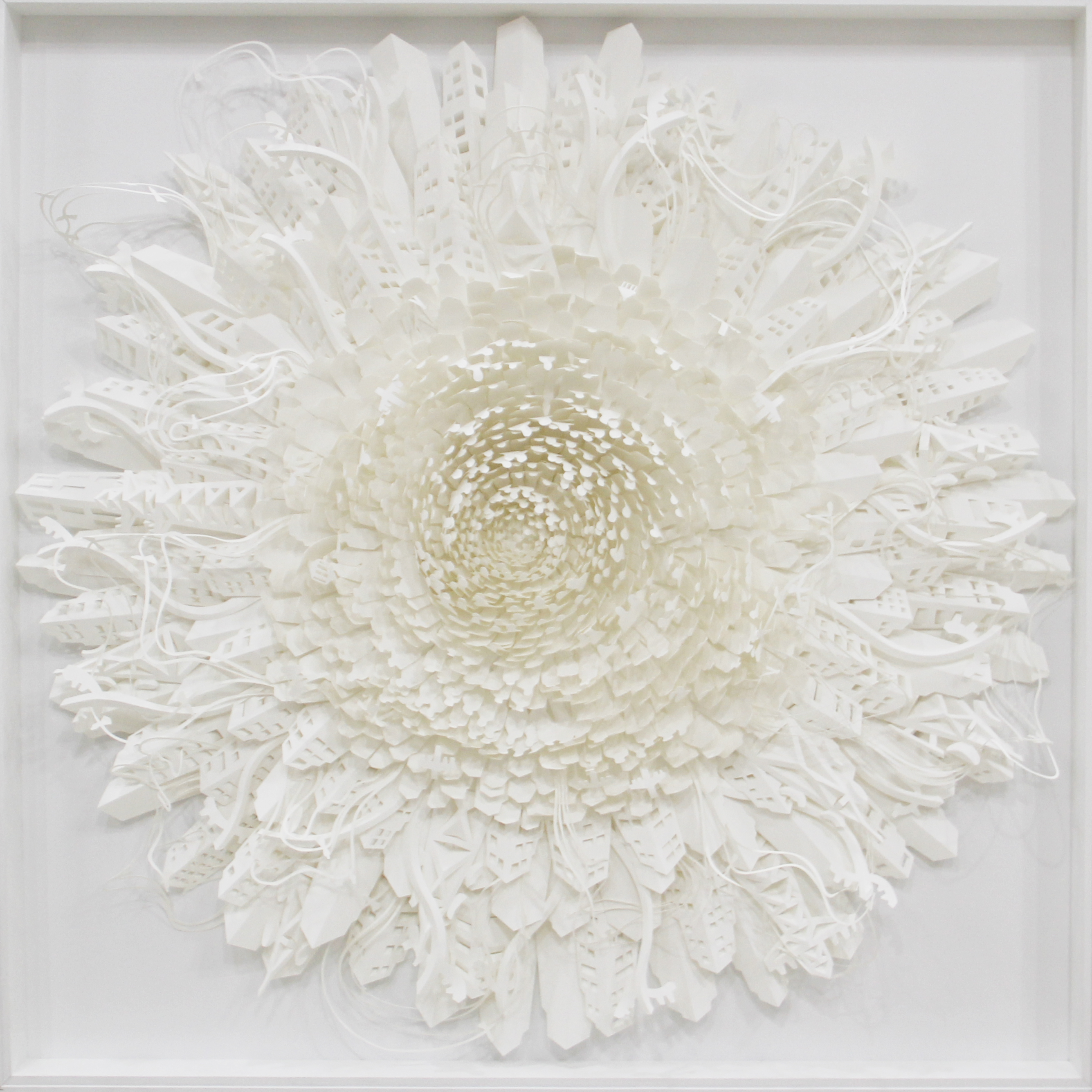
When it comes to creating the paper flowers, the first stage involves cutting the paper. I begin by cutting out different layers and details, separating them into different boxes. The assembly stage is where everything comes together, an amalgamation of all the thoughts and ideas I have gathered throughout the process.
Are all your pieces hand-cut? How long does a typical piece take to complete?
Yes, all the pieces are hand-cut, and completing a single work can take anywhere from two to four weeks, depending on its scale.
Themes & Meaning
Your work often explores ideas of “in-between spaces,” journeys, and even “nothingness.” What are you trying to express through these themes? How do they reflect your personal or philosophical inquiries?
At the beginning of my career, I was primarily exploring questions about how long mega-infrastructural structures would continue to be built, at what pace, and at what cost. These same questions began to emerge in relation to my own emotional journeys: how long and how far would I continue to navigate these in-between spaces? Over time, my exploration expanded to themes of finding balance, understanding the duality inherent in every scenario, searching for one’s purpose, and eventually confronting and accepting the absurdity within it all.
I believe this inward exploration began to take shape more profoundly after I became a father. Although these themes initially emerged as a means of personal introspection, they were always reflected in my work, primarily through the forms of cities and their elements.
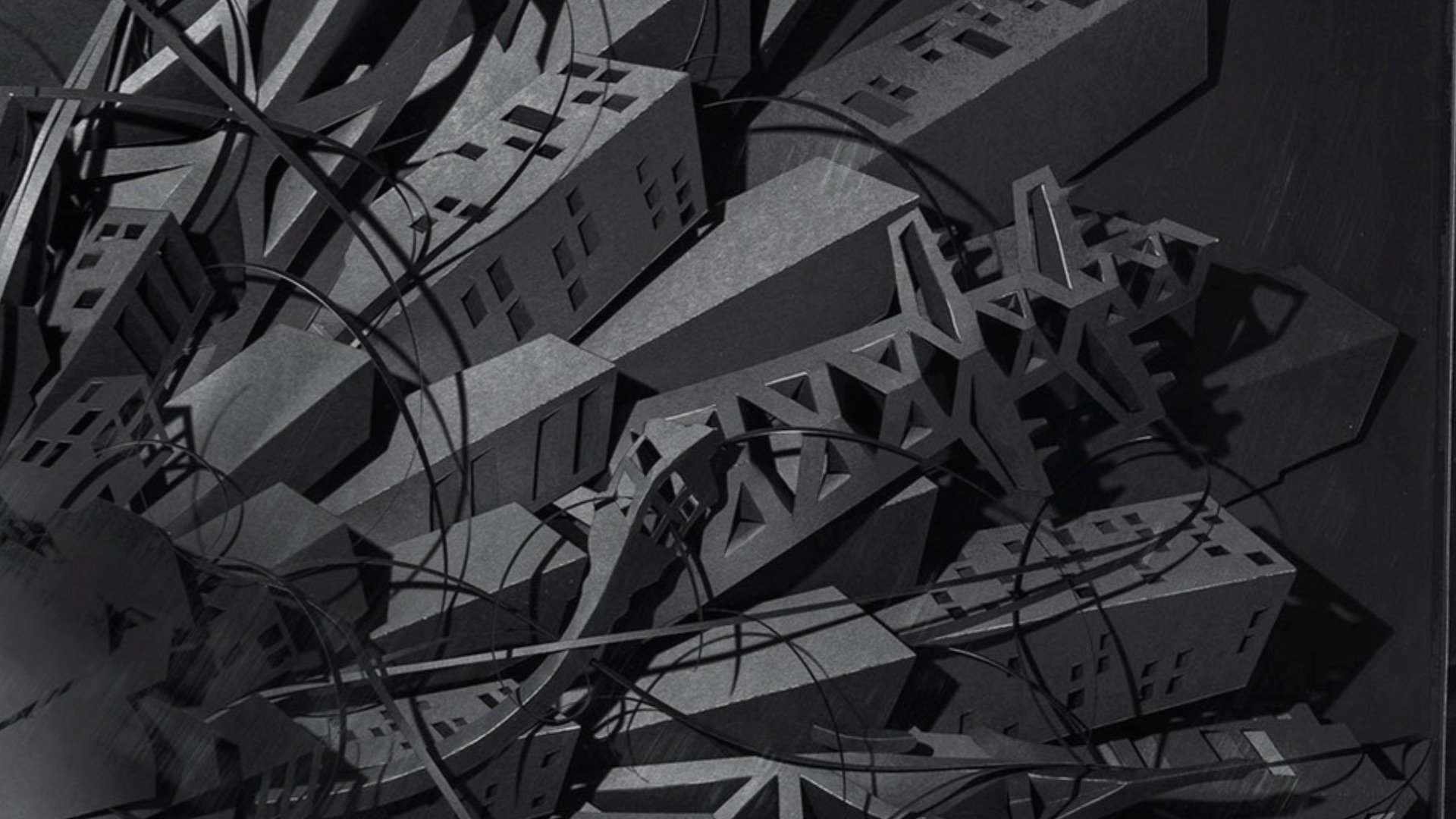
The city, with its chaos and layered realities, also appears frequently in your work. How did the urban landscape become a source of inspiration for you?
I grew up in a small, lush green town in Kerala, India. I believe that growing up in a rented home, with the promise of one day having a house of my own, sparked my childhood curiosity about architecture and the people who inhabit it. As I grew older, I moved to different cities to pursue higher education and advance my professional career, which also allowed me to travel further afield.
The idea of living multiple lives within a city fascinated me, particularly how homes and, by extension, stories were stacked upon one another, yet remained deeply intertwined, flowing seamlessly into each other. What mesmerized me was the city’s constant state of transformation, where displacements unfold and dreams take shape, are built, and continually reinvented.
You often depict flowers in your work. Is there a particular meaning or symbolism behind this recurring motif?
The idea that each city possesses its own unique textures has always fascinated me. Through travelling, I began to notice how a city’s history and urban fabric shape its inhabitants and influence their behaviours. This relationship was something I was keen to explore in my work, particularly as I became aware of how my own way of speaking and working changed as I moved between cities.
I began to imagine the city as a large, beautiful, chaotic, carnivorous flower, one that devours its prey, yet continues to attract those who return despite being aware of the chaos within it. I saw it as a larger-than-life, constantly active organism, simultaneously alluring and destructive. This image of the city as a living, breathing flower became the starting point for my exploration of this recurring motif in my work.
The Future
You’ve completed several large-scale installations and public projects; do you have a personal favorite? What made it stand out for you?
My favourite project has always been the one I am currently working on. Each new project stands out because I often find myself creating artworks that I would never have imagined I was capable of making. I am frequently surprised by what I have just completed, as each project takes me into unexpected territory and reveals new possibilities in my practice. At the back of my mind, however, the very first flower in my work will always hold a special place in my heart. It represents the first metaphorical seed from which my artistic exploration began to grow.
How do you see your practice evolving over the next couple of years? Are there any new ideas or mediums you’re excited to explore?
I see myself continuing to push the boundaries of paper as a medium, exploring possibilities that have not been explored before. I’m also excited to see how my work in stainless steel evolves, particularly as I begin to create larger-scale pieces. Additionally, I’m interested in exploring the narratives that painting and colour can convey stories that perhaps cannot be expressed through paper alone. Beyond experimenting with different materials and mediums, I feel that my practice is becoming increasingly personal. As I navigate the outside world, my inward journey is finding its way into my artworks. I see these two worlds, the internal and the external beginning to resonate with and intertwine with one another, each shaping and informing the other.

Add a comment